- The IndyCar Afterburn
- Posts
- Redefining the IndyCar Triple Crown
Redefining the IndyCar Triple Crown
Gentlemen, a short and revised view back to the past...

Connor Bunnell
April 13, 2026
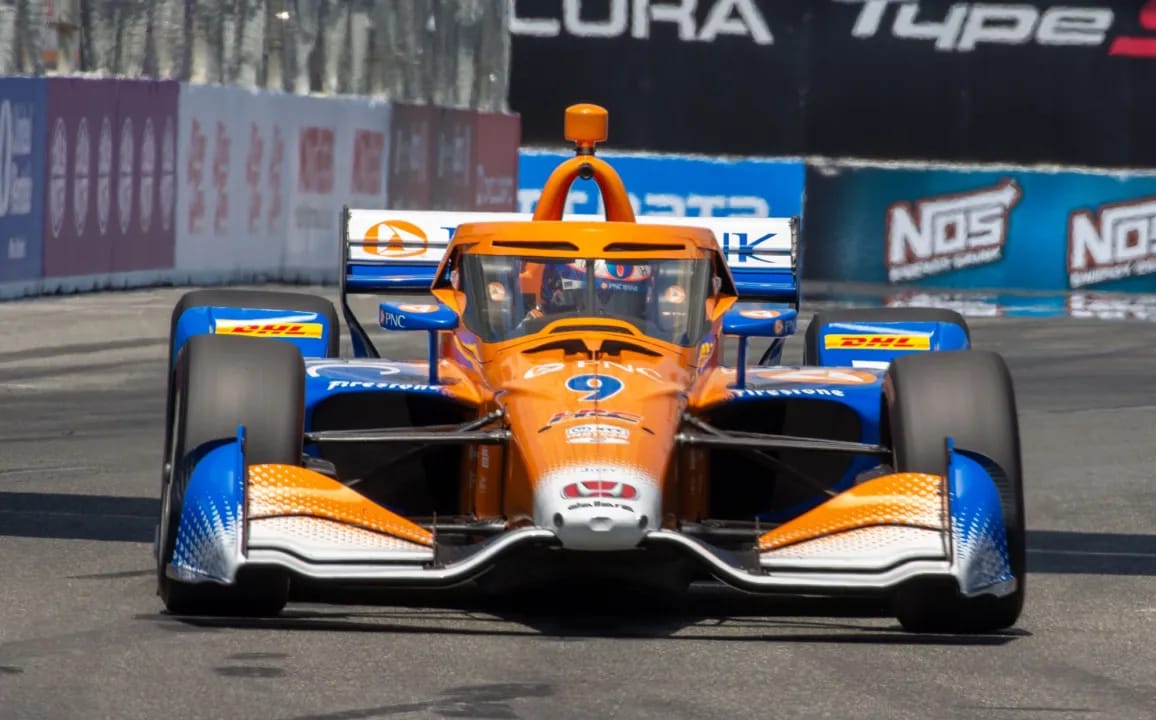
This is the first time since the IndyCar season started that I’ve had the chance to stop and catch my breath. Given the usual lethargic pace at which the schedule starts, that’s not something I ever expected to say. But while we’ve got this lull, I’d like to take an idea I’ve had rattling around in my head since around the time I started this newsletter and share it with all of you. I hope you’ll indulge me.
For a professional driver, there’s nothing that says you’ve reached the pinnacle of motorsport quite like a Triple Crown. Of course, the main prize of the Indianapolis 500, Monaco Grand Prix, and 24 Hours of Le Mans still belongs exclusively to Graham Hill—with potential arguments for Mario Andretti and Juan Pablo Montoya, depending on whether you count Le Mans class wins—but there are various countries and disciplines where variations can be achieved. Endurance racers can conquer the combined 60 hours of Le Mans, Daytona, and Sebring; NHRA drag racers can blaze to victories at the Winternats, the Big Go, and the Finals; and V8 Supercar drivers can dominate Sandown and Bathurst on their way to a season title.
Throughout the 1970s and ‘80s, plus a few years of the 2010s, IndyCar drivers had a Triple Crown of their own to pursue, consisting of three 500-mile oval races at Indy, Pocono, and either Ontario, Michigan, or Fontana, depending on the year. Yet despite various incentives for drivers to chase it, including cash prizes, trophies, and bonus championship points, the concept never quite got off the ground. Even Big Al Unser, who won all three races in 1978, couldn’t quite infuse the Crown with the magic its creator wanted.
Looking back, the big problem with the original IndyCar Triple Crown is that it was completely uneven. When Pocono joined the schedule for 1971, general manager Bill Marvel wanted to add instant prestige to the new event, and so introduced the Crown in an attempt to place it in the same conversation as the established marquee races. To an extent, it worked, especially in the ‘70’s and early ‘80s when the track was in its prime, but it also meant that the Crown’s existence hinged entirely on this one track—Indy is already part of the overall Triple Crown, and the third spot just went to whatever other 500-mile oval race promoters and sponsors wanted in the group. So when Pocono devolved into a rough, poorly-attended track, dropped off the schedule, then came back as one marred by the crashes that took Robert Wickens’ legs and Justin Wilson’s life, the whole thing went down with it.
It also doesn’t help that, in that time, NASCAR has grown from a regional curiosity to the league most associated with oval racing worldwide. The Indy 500 still remains the most prestigious oval race on the planet, but IndyCar’s other ovals are now overshadowed by such NASCAR staples as Talladega, Darlington, Charlotte, and especially Daytona, the Brickyard’s only true rival for the title of America’s most iconic raceway.
So here’s my solution. Instead of dwelling on an achievement that’s likely never coming back, let’s make a new Triple Crown emphasizing what really makes Indy racing special: its variety. With its relatively even spread of road courses, street circuits, and ovals, the modern IndyCar schedule tests drivers’ versatility like no other racing league. If you excel on two types of tracks, but struggle on the third, you’ll likely find your championship hopes thwarted year after year, and if you only ever get results on one type, you’re gonna be scrounging for deals with backmarkers instead of a stable contract with a top team.
Therefore, a new Triple Crown would consist of the most prestigious road, street, and oval races on the calendar. Two of these tracks basically pick themselves—if you know anything about IndyCar, you know that the Indy 500 and the Grand Prix of Long Beach are the two most iconic stops on the national championship trail. But while there are no shortage of contenders for the road course slot—Mid-Ohio has hosted Indy racing the longest in this category, Portland has produced some of the closest finishes in the sport’s history, and Laguna Seca bore witness to the most iconic pass of all time—I’d personally give the honor to Road America. The unique challenge its winding four miles present make it widely loved amongst fans and drivers alike, and it ensures the three most-visited states in American open-wheel history, Indiana, Wisconsin, and California, each have a track to represent them.
With the tracks established, we can now put together a list of winners, and it naturally produces a stacked lineup. However you slice it, Mario Andretti was the first to complete this Triple Crown. After his lone 500 win in 1969 and a Long Beach victory in 1977, when it was part of Formula One, the Andretti patriarch took the first of his three Road America victories in 1983, followed by his first CART Long Beach win in 1984.
Over the next couple decades, many would come close, but never quite put the Crown together. A family jinx kept Little Al Unser from ever winning Road America, despite his two 500s and record six wins at Long Beach. Juan Pablo Montoya won Long Beach in his rookie year of CART and won the 500 twice in as many decades, but in his three races at Road America, his best finish was 7th. Emerson Fittipaldi, meanwhile, won two 500s of his own and matched Mario for Road America wins, but could never quite crack Long Beach, racking up several silvers and bronzes without a win. Jacques Villeneuve, the last man to win the F1 World Drivers’ Championship with Williams, won both Indianapolis and Road America on his way to the 1995 CART championship, but never came back to try and take Long Beach, where he raced just twice and had a best finish of 15th. Sébastien Bourdais’s domination in the Champ Car World Series produced three straight wins at Long Beach, plus a win at the final Road America before reunification, but the 500 was never kind to him, as he peaked at 7th in 2014. But even that was closer than Alex Zanardi—who, thanks to only racing in Split-era CART and losing his legs in a 2001 crash, never even got to try Indianapolis, though he did win the other two jewels of the crown. Besides, he’s won four Paralympic gold medals since that accident, so the universe gave him one hell of a consolation prize.
Michael Andretti is a bit of a border case, matching his father’s three wins at Road America and winning twice at Long Beach, but his first Indy 500 win came as an owner, when Ryan Hunter-Reay kicked off a dynasty of three Andretti driver wins in four years. And if you tell Paul Tracy about this Crown, he’ll tell you he owns one too. He’s won four times at Long Beach, twice at Road America, and famously still contests that he, not Hélio Castroneves, was the rightful winner of the 2002 Indy 500. Either way, Castroneves wouldn’t have this Crown himself, as despite winning both Indianapolis and Long Beach in 2001, he’s only ever managed the bronze at Road America. That said, Castroneves can still join the club as early as this year, at least in that borderline Michael Andretti way, if either driver at Meyer Shank Racing wins Road America.
But back in reality, the second undisputed Triple Crown wouldn’t be completed for 25 years, not coincidentally taking after the Split was fully resolved. Dario Franchitti, the great Scotsman with one of the most Italian names in racing, started his road to the Triple Crown in 1998, when he took his first CART victory at Road America. Long Beach could’ve been in his grasp sooner, as he was the runner-up in 1998 and ‘99, but it wasn’t to be just yet. The next piece came on the other side of the Split in 2007, when he won the first of his three Indy 500s en route to the first of his four National Championships. Then, in 2009, Franchitti finally took Long Beach, making him a member of this illustrious club.
With American open-wheel racing back under one roof, we’ve had another crop of greats vying for this Triple Crown—and, again, many who’ve fallen just one jewel short. Simon Pagenaud won Long Beach in 2016, the first of five wins in his championship season, and took the 500 three years later, but only ever managed 4th place at Road America before a gnarly crash there in 2023 ended his career. Takuma Sato made history as the first and to date only Japanese driver to win the 500 and Long Beach, but again, has only made it as high as 4th at Road America, and will likely not complete it as a driver since he stopped running outside ovals after 2022. Ryan Hunter-Reay got closer, with a runner-up at Road America in 2018, but never got that third jewel. You can see the theme here. In the modern era, Elkhart Lake is where Triple Crown hopes go to die, especially since it was off the schedule for a number of years after the Split ended.
But a fair few currently-active drivers have managed to put it all together. And as you’d expect, Scott Dixon was the first to join those ranks. Like Franchitti, one jewel arrived long before the other two—in Dixon’s case, it was in 2008, when he won his lone Indy 500. Seven years later, he took his first win at Long Beach, and in 2017, Dixon won at Road America, making him the third undisputed holder of the Crown.
But we wouldn’t have to wait nearly as long for the fourth to arrive. Will Power started his road to the honor in 2008, when the Australian won the last race ever held under the Champ Car banner at Long Beach. As with Franchitti and Dixon before him, though, the rest of the puzzle didn’t start to come together until years later, specifically 2016, when Road America made its long-awaited return to the schedule and Power welcomed it back with a win. And like those predecessors, he’d finish the job two seasons later, when he became the first Australian to win an Indy 500.
The next man to join the club, however, wouldn’t bide his time like all the others. He had a very different plan for success. After two seasons with F1 backmarkers and a pedestrian start to his IndyCar career, Alexander Rossi came out of nowhere to win the Indy 500 on his first try, famously crossing the finish line while out of fuel. Two seasons later, he’d similarly ambush Long Beach. After coming 20th and 19th with a DNF in his first two tries, the third time was the charm, as Rossi took his third career win and first in his home state. After repeating the feat the next year, it all came together at Road America, where he once again broke out of a middling track record and blitzed his way to the top step, making Rossi the fifth Triple Crown winner, the third driver to complete one in as many years, and the fastest by a wide margin. Sure, he only has eight career wins in IndyCar, but if nothing else, he knows how to win the big ones.
And we’re still not done with the active Triple Crown winners, because number six was already on his way. The same year Rossi took Long Beach, Josef Newgarden won Road America, where he’d finished second the year prior. He similarly started knocking on the door for Long Beach soon afterward, finishing second in 2019 and 2021 before checking off the street circuit in 2022. Just for good measure, Newgarden would continue his Road America dominance, with another win that same year and two runner-ups since then.
But of course, the big hangup with Newgarden for years was that, despite all his success on ovals, the 500 was the one he just couldn’t crack. That finally changed in 2023, where Newgarden made a dramatic pass on Marcus Ericsson in the final lap to get his face on the Borg-Warner Trophy. And in case there was any asterisk on that from the odd flag choices, Newgarden pulled it again on Pato O’Ward the year after, this time in a straight-up fight under green.
So with those four guys going around, we have to ask, is the next Triple Crown winner already in our midst? Álex Palou seems like the natural next in line with his overall dominance. He got Road America out of the way first, winning it in every odd year since joining Chip Ganassi Racing, and he demolished the “can’t win on ovals” critique for good when he won 2025’s Indy 500. However, he has now podiumed three times at Long Beach without a win, so the street portion of the Crown could still be his downfall.
We’ve also got three one-leggers in the field for 2026. As of this writing, Kyle Kirkwood has won twice at Long Beach, Felix Rosenqvist’s lone win came at Road America, and Marcus Ericsson’s Indy 500 win in 2022 stands as the defining achievement of his career. And, of course, there are those like Pato O’Ward and Scott McLaughlin, who haven’t won any leg of this Crown yet, but seem destined to win at least one of them.
So if you somehow needed more storylines to keep in mind as you watch Long Beach next week, here’s the excuse you were looking for. If it ends up being just me that believes in this version of the Triple Crown, hey, it’s not like something being unofficial ever stopped me from tracking it in the race recaps. Thanks again for indulging me, and I’ll see you either this time next week for the Long Beach recap or sometime before then if the last couple Indy 500 drivers get announced.